

| Other Names | Verde Saint Denis | |
|---|---|---|
| Availability | Inquire | |
| Finishes | Polished, Honed, Sawn, Rockfaced, Sandblasted, Tumbled, Acid Wash, Antique | |
| Country of Origin | Italy | |
| Absorption | 0.3-0.6% | |
| Fire Performance | 0 flame spread (per ASTM E 84) | |
| Freeze Thaw Resistance | Good | |
| Panel Sizes | Up to 4'×8' (1220mm×2440mm) | |
| Structural Performance (on Honeycomb) | Excellent |
Verde St Denis Marble Panels by StonePly
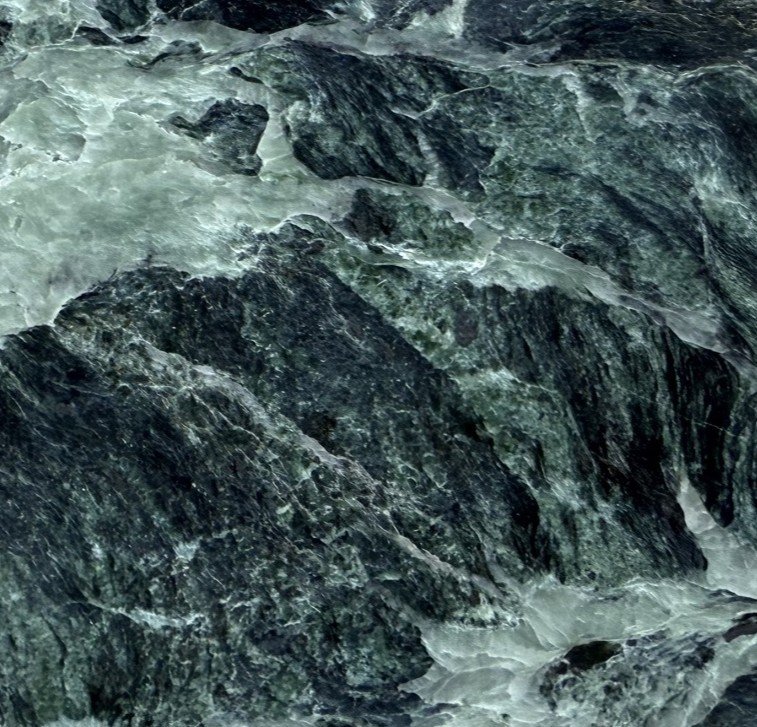
Verde St. Denis Marble displays a complex composition of deep forest green and dark charcoal tones layered with lighter jade and mineral veining. Large areas of darker green are intersected by branching networks of pale green and white calcite veins that move dynamically across the surface. The pattern is highly expressive, with sweeping mineral formations and crystalline textures that create strong visual contrast between dense green fields and luminous veined structures.
Within interior architecture, the material is frequently incorporated into lobby feature walls, atrium cladding, and gallery environments where a richly patterned stone introduces depth and visual movement. Hospitality interiors, cultural venues, and institutional spaces often integrate Verde St. Denis Marble as a vertical architectural surface that anchors interior compositions with a bold natural material.
StonePly panels are fabricated by bonding a thin layer of Verde St. Denis Marble to an aluminum honeycomb backing. This composite panel configuration significantly reduces overall panel weight while preserving the visual and material character of Verde St. Denis Marble. The fabrication process produces lightweight units designed for integration into contemporary cladding assemblies, allowing Verde St. Denis Marble to be incorporated into demanding vertical architectural applications.
For additional information regarding finishes, panel configurations, or technical resources related to Verde St. Denis Marble, please contact StonePly for more information.
Additional Reading
You are probably more familiar with marble than you realize. From Michelangelo's mighty carrara marble David, to the intricately carved cenotaphs of the Taj Mahal, to the royal Marble Arch of Buckingham Palace, marble has been the stuff of civilized architecture and art for centuries. Being a form of limestone, it is softer than granite, making it more susceptible to deterioration and wear but a simple, regular maintenance routine will keep marble looking beautiful.
Marble has a soft, sophisticated aura. Small interior spaces will especially benefit from marble's less "busy" feel when compared to granite thanks to its large, flowing veins.
Certain marbles can be “book matched,” meaning the edges of two panels are paired to create a mirror image. Book matching's effect is best expressed on large panels.