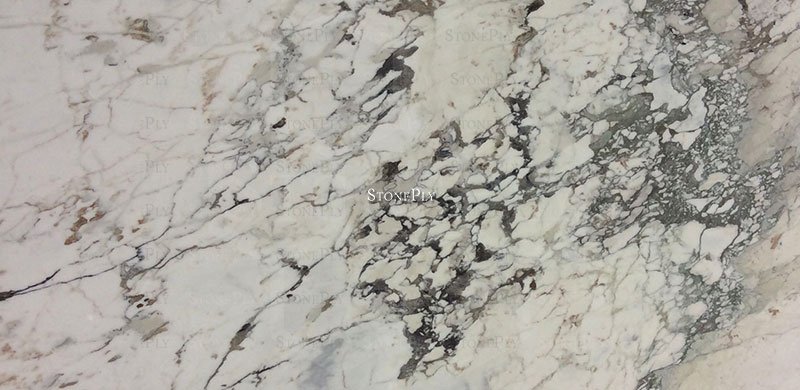


| Other Names | Fior di Pesco Apuano, Breccia Capraia Viola, Breccia Capraia Classico | |
|---|---|---|
| Availability | Inquire | |
| Finishes | Polished, Honed, Sawn, Rockfaced, Sandblasted, Tumbled, Acid Wash, Antique | |
| Country of Origin | Italy | |
| Fire Performance | 0 flame spread (per ASTM E 84) | |
| Freeze Thaw Resistance | Good | |
| Panel Sizes | Up to 4'×8' (1220mm×2440mm) | |
| Structural Performance (on Honeycomb) | Excellent |
Breccia Capraia Marble Panels by StonePly
Breccia Capraia Marble is composed of fractured white and pale gray stone segments suspended within bold burgundy and charcoal veining that cuts sharply across the surface. The irregular junctions between these fragments create a layered, high-contrast composition, where dense mineral lines and open fields shift in scale and intensity, giving the stone a distinctly graphic and directional presence.
Across exterior building skins, this stone can be used on facade planes, entry volumes, and vertical transitions where variation in patterning adds depth to the overall composition. Inside, Breccia Capraia Marble can be carried through lobby walls, feature partitions, and circulation corridors, allowing the fragmented pattern to move across adjoining surfaces without appearing repetitive.
StonePly panels use a thin cut of Breccia Capraia Marble bonded to an aluminum honeycomb backing, producing a lightweight panel with uniform thickness compared to traditional stone. This approach allows Breccia Capraia Marble to integrate into a range of cladding systems while helping streamline installation and coordination with modern building envelope assemblies.
For additional information regarding finishes, panel configurations, or technical resources related to Breccia Capraia Marble, please contact StonePly for more information.
Additional Reading
You are probably more familiar with marble than you realize. From Michelangelo's mighty carrara marble David, to the intricately carved cenotaphs of the Taj Mahal, to the royal Marble Arch of Buckingham Palace, marble has been the stuff of civilized architecture and art for centuries. Being a form of limestone, it is softer than granite, making it more susceptible to deterioration and wear but a simple, regular maintenance routine will keep marble looking beautiful.
Marble has a soft, sophisticated aura. Small interior spaces will especially benefit from marble's less "busy" feel when compared to granite thanks to its large, flowing veins.
Certain marbles can be “book matched,” meaning the edges of two panels are paired to create a mirror image. Book matching's effect is best expressed on large panels.