
Seismic Loads
StonePly panels can flex. In real world earthquakes and laboratory simulations, StonePly has proven its ability to flex, twist and move with the structure. While traditional stone slabs crack and break when stressed, StonePly’s composite structure allows the stone to flex with the aluminum. The stone is bonded to the substrate over every square centimeter of its surface, so it stays with the aluminum and flexes. As a demonstration of this ability, we bent this flat StonePly panel over a mandrel forcing it to bend. Note that the stone stays bonded to the aluminum. While the stone flexes, it does so through micro cracks, too small to see. This property is also valuable for blast resistance of the material.
In earthquake prone regions, the use of StonePly offers several benefits over traditional stone panels and stone cladding.
- StonePly is lighter in weight than cast stone, granite, marble, travertine, limestone or precast concrete.
- StonePly is reinforced throughout. Because the aluminum is bonded to every square centimeter of the stone. there are no unreinforced areas in a StonePly panel to break off in an earthquake.
- StonePly has the ability to flex.
Because of the ability of StonePly to flex without breaking, is ideally suited for use in seismic zones. Unlike rigid stone panels, StonePly can accept a considerable amount of bending forces and vibration without cracking or breaking.
The two main considerations in the design of StonePly panels for use in seismic regions are:
- The anchoring system which ties the StonePly to structure.
- The jointing design which allows for the maximum wracking of the structure.
All the major building codes have maps of seismic zones, which rate various regions, depending on the potential severity of earthquakes in that region, and all designs should be in accordance with local building codes.
Seismic Loads and stone panels
Overview
Lightweight StonePly panels offer a resilient, flexible and inherently safer cladding material than common stone cladding.
In a seismic event, the building deflects as the ground shifts. Lightweight, ductile StonePly natural stone panels are inherently better able to move with the structure than heavy, brittle stone.
The problems with common stone cladding systems and earthquakes are:
- Common stone cladding is heavy at over 27 lbs per square foot.
- The stone cladding weight creates additional strain on the building structure in a seismic event.
- The heavy stone can be lethal when it falls even a few feet.
- The inherently brittle stone cladding generally relies on a groove cut at the edge of the stone and anchored. This leaves only thin tabs of stone, only at the edges, to resist the seismic loads of the entire panel.
With non-structural components such as stone cladding, the main emphasis of seismic design is on life safety by reducing the hazard of falling debris. The common method of attaching a stone façade or cladding is with 1 3/4" to 3" stone slabs and stainless steel anchors set into "kerfs" or grooves in the stone edges. That leaves a thin tab of stone to attach the cladding to the structure. Since common stone cladding is inherently brittle, movements in supporting structure can lead to the kerfs breaking or the stone becoming dislocated and falling.
The seismic design of common stone cladding systems relies mostly on attempting to isolate the rigid brittle stone from the movements of the other stones and the structure. Unfortunately, the US earthquakes in the recent past have shown the vulnerability of this design. There have been several instances of cladding becoming cracked or dislodged and crashing to the ground. A piece of 1 ¾” stone as is used in common stone cladding, at 27 lbs per square foot, can be lethal when it falls even from a few feet.
In addition to the life safety hazards, earthquake damage to building cladding can be expensive. The 1996 Northridge earthquake caused an estimated $1.1 billion in damage to building envelope wall systems alone.
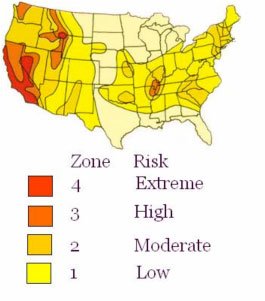
USA Earthquake Hazard Map
The solution for stone cladding in earthquake zones
- StonePly stone panels are lightweight (3.3 lbs. per sq. ft.) and put a smaller load on the structure
- StonePly panels are bonded across every square inch to the aluminum substrate. With a bond strength of over 50,000 lbs per square foot.
- Attachment back to the structure is secure and safe
- StonePly stone panels are incredibly ductile. Even when deformed, the stone remains in place.
- The aluminum honeycomb and epoxy lamination were developed in our work with the US government. The technology used on military and commercial aircraft that stands up to intense vibration, deflection and impacts day after day. These laminates are designed to survive forces a building never could, including twisting and vibration far more intense than the most powerful earthquake, for thousands of hours.
The structural integrity of the StonePly stone cladding is not affected by temporary movement in a building from an earthquake. With the StonePly system, the small gravity load of each individual stone panel is securely anchored back to the substrate. In addition each cladding panel is separated from the others by high performance silicone.
The StonePly System utilizes less than 1/4" stone on an aluminum honeycomb panel.
As a lightweight cladding material, StonePly is ideal for earthquake prone areas.
At StonePly we have tested all the major stone cladding types: granite, marble, limestone and travertine for the adhesive bond strength in seismic conditions. With a bond strength of over 50,000 lbs per square foot and a stone weight of only 3 lbs per square foot, the ability of the epoxy adhesive to withstand an earthquake offers a safety margin of several thousand times.
Testing of large StonePly stone panels has been done to simulate seismic racking shear using 5,500 lbs of force to create a 2 1/2" (64mm) lateral displacement in an 8' panel. The panels were undamaged and material remained engaged.
What is Ductility?
To demonstrate the bond strength of the stone and epoxy bond and the ductility of the StonePly system we forced this thin granite panel through a roller.
The stone remains in place even after a 30% displacement. The trait of ductility allows StonePly to resist the design level seismic forces, and in the event of a catastrophic failure of the building structure, to deform excessively, but remain intact.
When you combine the earthquake resistant properties of StonePly with the hurricane resistance, blast resistance, impact resistance and fire resistance of the StonePly system, no other stone cladding offers you more peace of mind.
Please contact us with any StonePly stone cladding questions. We are here to help. Unique applications and unusual or differing criteria should be reviewed by a professional engineer.


